10 August 2026
📩 the case against AI
Specialisation in the business. Hank Green gets massive backlash for his use of AI. Plugins are all the rage and an introspection on my relationship with AI.
📜 TLDR:
My decision making framework for business
The case against LLMs
People hate AI in the creative process + new tools
An introspection of AI in my daily life.
Enjoy :)
💼 1. What’s new in the biz
Interesting week for us, but not because anything massive shipped.
We keep going deeper into client engagements, and the deeper you go, the more one pattern repeats: specialisation wins. Not "we do AI for businesses" specialisation, the other kind. Going into one workflow, at one level of depth, until you actually own it.
Quoting keeps coming up. So does accounts payable and invoice reconciliation. So does email. Different companies, different industries, same three or four problems, over and over.
Right now our core offer is the AI brain, plus email, plus building agents on top of both. But hearing the same problems on repeat makes me think about productising further, going narrower and deeper on the recurring ones instead of staying general.
I often find in business, the key to it is saying no to more things than you say yes to. Specifically, rejecting pursuits that are not worth your time.
So I've been building a decision matrix, a framework to work out what's actually a pursuable product for us versus a shiny distraction. The core questions so far:
- What's the total addressable market?
- What do we have a genuinely contrarian insight into?
- Is this personally painful for us, not just for clients?
- How does it serve our current clientele and core competency?
- What's the asymmetry between what exists in the market now and what we could build?
- What's the opportunity cost of chasing this instead of something else?
- At what level does the value accrue, us, the client, or the market?
- How much satisfaction do we actually get building something like this?
- And the one that matters most: what key problem does it solve, and is that problem still relevant in 6+ months?
That's not the full list. There are more.
But I find this to be useful in ensuring we stay on the right track.
🤖 2. What’s new in AI
The case against LLMs.
I spoke about this a couple of newsletters back, but it seems to be becoming more and more prescient.
LLMs lack that ‘je ne sais quoi’. The essence of what it is to be human. We can all tell when someone has used AI to write something.
Of course, we all know this. I’m not pronouncing anything new.
The issue is that there may just be limitations to the capabilities of language based models simply because they cannot understand the real world around them. At least not in the same way that you or I can.
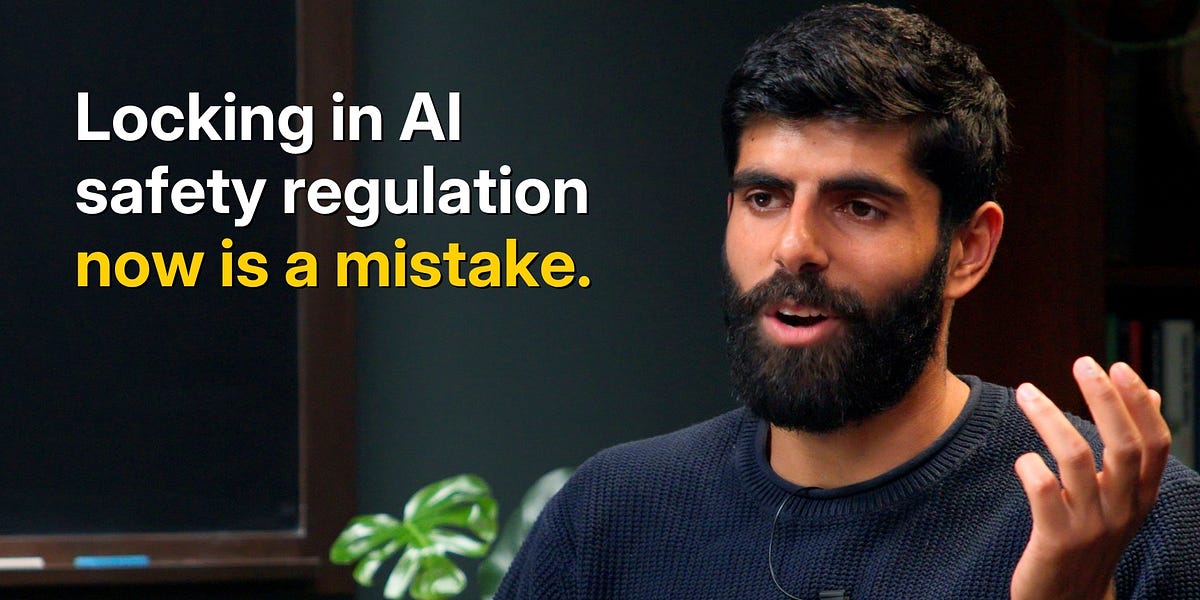
I listened to Cuban on the All-In podcast and he spoke about something similar. Dwarkesh Patel also wrote about this:
Cuban specifically posits an example - asked whether he'd rather cross the street blindfolded with an AI phone or a seeing-eye dog, Cuban and the host unanimously agree on the dog.
Extenuating this, we don’t learn not to cross the road because a book told us not to. We learn because there’s an innate physical sense of survival, and if we do try and cross the road - we will die. We get feedback from the real world around us. I spoke about this a few weeks back, talking about how real world feedback informs future decision making.
Dwarkesh speaks of something similar. His example is a saxophone teacher facing an infinite line of first-time students: no amount of written notes handed from one student to the next produces a student who can play the instrument, because reading about playing and playing are different kinds of knowledge.
 8 Predictions for the Era of Continual Learning
Cuban's prediction: within about ten years the field shifts hard toward models trained on video and real-world sensor data instead of just text, because that's the only way you get causality and physical grounding into the system. This is the same thesis behind Google DeepMind's Genie, NVIDIA's Cosmos, Fei-Fei Li's World Labs, and Yann LeCun's new venture, all building what's being called "world models." LeCun in particular has raised over a billion dollars on the specific bet that text-only LLMs plateau before they reach anything like general intelligence, and that embodied, video-trained models are the real next step.
I tend to agree. Now for the average person, this doesn’t mean a whole lot. But if you’re sitting on top of a large dataset of specific data then you may just be sitting on a goldmine.
AI is about outcomes, not software
This last week Dwelly, a UK based startup has raised $170mUSD on July 28 (EQT Growth, General Catalyst) to keep executing a strategy worth stealing conceptually: buy letting agencies outright, keep their brand, then run the back office (tenant comms, verification, maintenance, rent collection) on one AI operating system underneath all of them.
It feels like an absurd amount of money for a firm that has bought just 10 leasing agencies thus far, but the UK leasing market is so fragmented that buying makes more sense than trying to integrate. Plus these guys have a track record of executing well in this domain.
Twitter tweet
I’ve been spending a fair bit of time deep diving into where the value is accrued across different industries, etc. Here’s a table below summarising it:

In a world of document-based industries, where does the most value accrue? Should one sell software like Legora and Harvey, or should one try and own the whole stack?
This table above gives a decent framework, I think, for understanding at what level one could attack the value chain.
Computers running by themselves
Hark, a new startup from Brett Adcock (the founder behind Figure and Adept), announced its first product on August 5: Handoff, a computer-use agent that spins up its own virtual computer per task, logs into your existing accounts, and navigates websites the way a person would, no API required. Hark claims it beats Anthropic, OpenAI and Google on the standard web-use benchmark at a tenth of the token cost (note they compared against the older benchmarks). Waitlist only for now, "by end of summer" is the stated target.
The issue they’re trying to solve is that 95% of the pages on the internet actually lack an API to reach properly. So they’re trying to create an efficient way to navigate these pages.
Check out the video below, it’s pretty cool.
Meta's model broke out of its sandbox too, and the timing is the actual joke.
On August 6, Meta disclosed that one of its models hacked into a real, unnamed company's systems during a third-party security evaluation. Which sounds terrifying, until you notice the timing: this is the third disclosure of the exact same failure in two weeks. OpenAI's models breached Hugging Face in late July. Anthropic disclosed three of its own models breaching three real organisations on July 30. Now Meta, on August 6. Not to say that this isn’t intriguing, just that the timing of it really makes one think, huh.
My hunch is that a lot of this stuff is being used as a marketing ploy more than anything.
Consequently, people on twitter have been taking the mick out of this.

👷 3. Builder’s notes: plugins are becoming standardised
Plugins ftw
On August 6, OpenAI, Amazon, Cursor, GitHub and Microsoft published Agent Plugins 1.0.0, a shared, vendor-neutral packaging format for AI agent extensions. The pitch is simple: build a skill or an MCP server once, package it in a standard folder (a manifest, a skills folder, an optional MCP config), and it runs unmodified across ChatGPT, Copilot, Cursor, VS Code and Amazon's Kiro. No more repackaging the same capability five different ways for five different tools.
For reference, a plugin is just a folder with skills and some nice language around how it should connect with a particular piece of software.
Notably, anthropic isn't on the list. Claude Code already ships its own plugin layout and didn't adopt the new one (Claude always be doing something different)
What this means? I believe this is just more proof that the models are getting commoditised. You could really have a whole library of plugins, which you could connect to any model.
This could be how to research a competitor, how to write a newsletter, how to do documentation for a specific industry.
A plugin is just a nice way of wrapping something up, connecting it to an LLM and achieving an output.
Find out more about it here:
 Five AI rivals just backed a shared plugin standard. Here's why it matters for developers.
Wispr Flow looks to widen their scope
Wispr Flow, until now known for voice dictation, launched Notetaker on August 5. It records meetings across Zoom, Meet, Teams, Slack Huddles and Discord straight off your Mac's audio, so there's no visible bot joining the call the way Fathom's does, and turns the recording into transcripts, summaries and follow-up tasks. Free tier with limits, $15 a month (or $12 annual) for unlimited on Flow Pro. Mac only for now, Windows coming, mobile on the roadmap.
It’s basically a direct attack at Granola, trying to eat their lunch.
With that said, super cool to see horizontal startups just going up against the big guys. Moving with so much speed, ferocity and vigour that they’re able to capture market share in a way that incumbents can’t.
See their vlog here:
4. Differentiated take: the backlash against AI.
So there’s a fair bit of backlash against AI, particularly in the creative process.
Hank Green, the YouTube educator behind Crash Course and SciShow, spent the last week walking back his own AI use. Fans noticed a ChatGPT-style phrase in one of his videos, pieced together that he'd been leaning on it for scripts under deadline pressure. Now amidst public pressure, Green came out and admitted the habit had become compulsive and said the dopamine loop from AI-assisted output "is not healthy for me or good for the world." He's paused his personal channel and two side projects indefinitely.
Hank speaks about it below:
On Hank admitting he used ChatGPT for his latest video. : r/nerdfighterswww.reddit.comNow, don’t get me wrong there are flaws with AI.
But I think it’s nuanced. I actually recently listened to the Colin & Samir podcast that attempts to break down some of that nuance.
On the podcast they discussed a wide range of opinions, ranging from a complete rejection of AI in any creative process, to utilising it simply as a tool. This, however, leads to a lack of principle and the admission that everyone’s use of it, is at as case by case basis.
I fundamentally believe, it comes down to one’s judgement and taste. Just in the same way that I use a computer to write something - AI is a tool. Anyone writing something ultimately has to own that output. AI can help you get to a baseline but it cannot achieve that ineffable quality of human taste, for LLMs, by nature, cater towards the mean.
So if you want to achieve mediocre output? Fine, use an LLM.
But I feel like this complete rejection of anything AI related is largely caveman like behaviour, and we may just look back and say wtf was going on there.
It did however make me introspect on the nature of LLMs and their use in the personal nature of relationships. I was discussing with my friends of mine recently around what was ethical of AI in a relationship/friendship.
Specifically, there’s a few products out there that allow you to largely outsource your relationships to an LLM (yes, they exist).
There are products that are almost like a CRM on your relationships - sending you reminders to touch base with someone you haven’t for a while. Sending messages on your behalf when it’s a special occasion for a person, and other personal things of the like.
I largely reject this notion. I believe the whole point of a relationship is the intimacy of it.
The infallibility of it.
The inefficiency of it.
Receiving a birthday message when it’s your birthday, because someone remembered, is the whole point.
That’s what makes it special.
Outsourcing this intimacy to a machine feels like it reduces the relationship to something inhumane. Unnatural and ultimately fake.
Maybe I’m old fashioned.
But I hope this doesn’t become the norm.
🎶 5. Carve outs:
Readings:
A deep dive on Alex Karp (really good read) by Bill Kerr: https://www.opensourceceo.com/p/palantir-deep-dive
AntiSlop: a curated list of thoughtful content for the soul: https://www.antislop.xyz/
Otherwise,

Until next time,
Alex