19 June 2026
📩 how to set up your second brain
This week going to be covering two additions to the WhiteHorse team. The US govt banning Claude's Fable model, how to set up your second brain and for my differentiated take: striving for glory in a modern world.
What up y’all,
For the TLDR for today. Going to be running through:
what’s new in the business: 2 employees added to the corp.
how to set up your second brain + new stuff in AI
striving for glory in a modern world.
Enjoy :)
💼 1. What’s new in the biz
We have 2 additions to the WhiteHorse family, Juan and Leo.
Juan has recently completed his masters in AI/ML from Monash University. Juan has worked at 3 separate startups before joining us. He’s based out of Melbourne (we caught up with him recently and somehow forgot to take a photo so here’s his LinkedIn profile picture).

Leo has joined us as one of our AI BDR and consultants. He’s studying Economics at USYD and has been put on a steep learning curve around AI and crushing it in the sales department at the moment. So if you submit an enquiry, that’s who you’re going to be speaking with.

So managing two new people is fun!
A funny note I’ve had while running an AI implementation company.
I’ve found you end up being a business consultant more than a technical developer. A lot of people want AI implemented (we’ve been talking with multiple companies doing $100m+ who are just trying to hire people to solve the issue), but the bigger issue is that they don’t have good processes or they don’t know where to start. They’ve either scaled too quickly, or they’re hearing all the buzz about AI and just don’t want fomo.
A tip for anyone trying to automate something.
Does it follow a repeated process?
Does this require a human to do? (e.g. wouldn’t recommend automating sales reps)
Is this costing me a lot of money? (e.g. if your quotes take a week to get back that’s a big red flag and could be costing you a lot).
That’s why we usually start with:
Audit (understand if AI can actually be helpful) →
Build (build out the agents that are going to move the needle) →
Optimise (implement self-learning feedbacks so the agents get smarter overtime).
But otherwise this week has been good, been running more facebook ads and trying to post more content - will be breaking down the GTM strategy in next week’s blog.
🤖 2. What’s new in AI (and what I’m actually using)
Building your second brain.
I’ve heard from people two really key things.
I want a second brain that knows me and gets smarter over time.
I want a setup that doesn’t lock me into Claude or ChatGPT.
Well you’re in luck. Here’s the exact setup I use as my second brain + I can switch between Claude or Codex or any model as I want (so my context isn’t stuck in one system).
I use this everyday now. Any serious Claude user I know doesn’t actually use the Claude desktop app. Everything (even if it’s not code) runs through VSCode (which is literally just an open-source code-editor).
Getting Started: build your second brain - you can view it on Github here (if you’re not technical, Github is basically like google drive for code - just a place where you can store all of your updates etc, it’s not scary I promise).
This guide takes you from nothing to a working AI executive assistant. No coding. If you can install an app and fill in a form, you can do this.
Set aside about 30 minutes. By the end you'll have an assistant that knows who you are, what you're working on, and how you write, and that gets sharper every time you use it.
Here's the whole thing in five steps:
Install Claude Code (the app this runs on)
Download this template
Open the template in Claude Code
Make it yours (the important part)
Use it
Step 1: Install Claude Code
Claude Code is an app from Anthropic (the company behind Claude). It's Claude with the ability to read and write files on your computer. That's what lets it hold a "second brain" instead of forgetting everything when you close the chat.
The easy way (recommended if you're non-technical):
Go to claude.com/claude-code.
Download the desktop app for your computer (Mac or Windows).
Install it like any other app and open it.
Sign in with your Claude account. (You need a paid Claude plan, or an Anthropic API key. The sign-in screen will walk you through it.)
That's it. Skip to Step 2.
The other way (if you're comfortable with a terminal): Claude Code also runs in the terminal and inside code editors like VS Code. If those words mean nothing to you, ignore this and use the desktop app above. If they do, the terminal install is one command: npm install -g @anthropic-ai/claude-code (you'll need Node.js first), then run claude.
Step 2: Download this template
This template is the skeleton of a second brain: a set of folders and files Claude reads to understand you. You're going to grab a copy.
Go to the template page: github.com/alexsidhu1/execassistant-template.
Click the green Code button near the top.
Click Download ZIP.
Find the downloaded ZIP file (usually in your Downloads folder) and double-click it to unzip.
You now have a folder called execassistant-template. Move it somewhere you'll remember, like your Desktop or Documents. You can rename it to anything you like (for example, my-assistant).
No GitHub account needed. You're just downloading a folder.
Step 3: Open the template in Claude Code
Open Claude Code. Or if you want to use VSCode simply download it from the internet here:
 Visual Studio Code - The open source AI code editor | Your home for multi-agent development
And then just open the folder inside of VSCode.
Open the folder you just unzipped. (In the desktop app, point it at the execassistant-template folder. There's an "open folder" or "open project" option when you start.)
Claude can now see all the files in that folder. When you start chatting, it automatically reads CLAUDE.md first, which tells it everything else to look at.
To check it's working, type:
Read CLAUDE.md and the files in the context folder, then tell me in one sentence what you understand about me so far.
Right now it'll say something about placeholders, because you haven't filled anything in yet. That's the next step.
Step 4: Make it yours
This is where the value comes from. The assistant is only as good as what it knows about you. Two ways to do this. Pick one.
Option A: Let Claude interview you (easiest)
You don't have to edit files by hand. Claude can do it for you. Paste this in:
I want to set up my second brain. Read CLAUDE.md and every file in the context folder. Then interview me one question at a time to fill them in with my real details. Ask about who I am, what my business does, my team, my current priorities, and my goals. After each answer, update the right file. Keep going until the context folder reflects my real life.
Then just answer its questions in plain language. It writes the files for you. This is the fastest way, and honestly the best, because it asks about things you might not think to include.
Option B: Edit the files yourself
If you'd rather type directly, open these files (in Claude Code, or any text editor) and replace the [bracketed placeholders] with your real information. Start here, in order of importance:
context/me.md — who you are, your role, how you work.
context/work.md — what your business does, your offers, your clients.
context/team.md — who's on your team and what to loop them in for.
context/current-priorities.md — what matters in the next 30 days.
context/goals.md — your targets for the quarter.
CLAUDE.md — change [Your Name] and the top description so it's working for you.
.claude/rules/communication-style.md — set the tone and formatting rules so it sounds like you, not generic AI.
Be specific. "I run a business" is useless. "I run a 4-person marketing agency in Austin, most revenue from retainer clients, trying to land bigger accounts" is gold. The detail is the whole point.
One rule that matters
Don't put anything in here you wouldn't want a stranger reading, unless you keep this folder private (it is private by default on your own computer). The folder lives on your machine. It only goes public if you choose to upload it somewhere public. For most people, it just sits on your computer and stays yours.
Step 5: Use it
Now it's an assistant. Talk to it like one. Some things to try:
"Draft an email to a client who went quiet, in my voice."
"What are my top priorities this week, and what should I ignore?"
"I'm thinking about hiring a salesperson. Talk it through with me using what you know about my business."
"Summarize this messy note into three clear next steps." (paste the note)
Tell it to remember things. When you correct it or state a preference, say "remember that." For example: "Remember that I never want emojis in client emails." It saves that and applies it next time.
Log decisions. When you make a real call, say "log this decision." It writes it to decisions/log.md with the reasoning, so future-you knows why.
Build skills as you go. The first time you do a repeatable task (a weekly review, a follow-up email, a content draft), do it once. The second time, say "turn this into a skill so we do it the same way every time." Now it's a reusable recipe. There's one example skill in .claude/skills/weekly-review to show you the shape.
What "gets smarter over time" actually means
Nothing about this is automatic magic. It compounds because of you. Every time you correct it, add context, log a decision, or save a skill, the next conversation starts from a higher floor. After a few months it knows your business the way a good employee would, except it never forgets and it's there at midnight.
The hardest step is the first one: filling in the context honestly. Do that, and the rest takes care of itself.
Stuck?
If something isn't working, ask Claude Code directly. It can see your files and your setup, so "I followed the getting started guide and X isn't working, help me debug it" usually sorts it out. That's the nice thing about an assistant that lives inside the tool: it can help you fix the tool.
New in AI
The US government pulled an AI model off the internet.
On June 9 Anthropic launched its most capable model yet, Fable 5. Three days later the Commerce Department sent a letter ordering them to cut off access for any foreign national, anywhere in the world. The scope was so broad that Anthropic just shut the whole thing down. Globally. For everyone. As of this week it's still dark.
The stated reason was a jailbreak that exposed some cybersecurity capabilities. The likelier reason, per the reporting, is an ongoing feud between Anthropic and the administration (the Pentagon labeled them a "supply chain risk" back in March).
Interesting to note, that this is the kind of scenario that was outlined in the AI 2027 paper (which I would recommend reading if you haven’t already). Essentially, where AI becomes so good, it becomes weaponised and a matter of national interest, no longer just a chatbot for the public to play with.
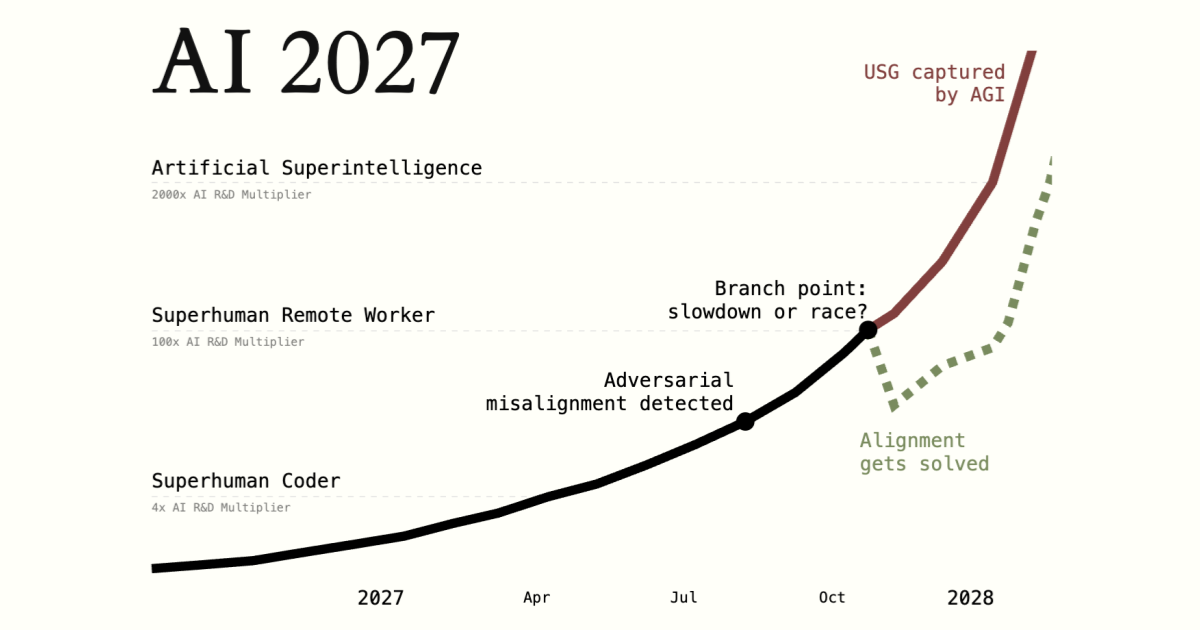 AI 2027
SpaceX went public, and Musk became a trillionaire
Biggest IPO in history. SpaceX listed on the Nasdaq on June 12, raised $75 billion, and closed day one up 19% at a $2.1 trillion valuation. That's more than double the $800 billion it was worth privately back in December.
The company loses money on $18.7 billion of revenue. So buyers are paying roughly 112x revenue for an unprofitable business. The market isn't pricing what SpaceX is. It's pricing what Starlink and Mars become. I.e. if S
Worth noting: Anthropic and OpenAI are reportedly next in the IPO queue. The big AI and space money is moving from private into public.
🧐 3. Striving for Glory in a world that often caters towards the mean
I was talking with a friend recently. And we were talking about the idea of glory. What is it, what it means and how to strive for it in a modern world.
One thing he said that was particularly noteworthy, was that he'd rather live as a criminal who went down swinging, who took real risk, who had moments where everything was on the line and pulled through, than live comfortably as a product manager at some tech company.
I resonated with this (not the criminal part but taking risk). I remember being 16, a friend describing the life he wanted: send his kids to the same school we went to, work in finance, run the same cycle his parents ran. Nothing wrong with it. But I remember thinking, clearly, "there has to be more."
This want is not new. Its rooted in ancient greek mythology. The oldest story about it is Achilles. The gods give him a choice: stay home, live a long and comfortable life, and be forgotten, or sail to Troy, die young, and have his name sung forever. The Greeks had a word for the thing he chose. Kleos. The glory that outlives you. It literally means "what others hear about you." He picked an early death to get it.
Young, ambitious people used to leave home to conquer and explore.
Sometimes I feel like a lot of problems have already been solved. A lot of the world has already been explored. That we showed up too late to explore the continents and too early to explore the galaxies. I think this is rather nihilistic.
And so rather, I think the medium of glory has changed. But the want underneath it is as old as that choice.
Strip it back and glory is simple. Do something hard, something others aspire to, (and notably, have people see it/hear it).
It’s important to note here though, that glory is not status.
The Greeks split these too. Timē was the honor handed to you by your rank. Kleos was the renown you earned by the deed. Status is a position other people grant you. Glory is a deed. You can hold status your whole life and never do a single thing worth telling a story about. And you can earn glory in one moment with no title at all. The stranger who steps in when a woman is being robbed has it. The comfortable executive who walks past does not.
I’ve looked back in time to understand this further. A prominent figure of this unabashed pursuit of glory was Churchill.
I recently read the biography by Boris Johnson. In it, Churchill strove to be at the centre of the action all the time. To put himself in positions where there were real stakes (e.g. his willingness to be on the frontlines at the Boer Wars).
The book details how he looked at Napoleon and openly wanted that kind of impact on the world, and said so without flinching. He had status for decades. But the glory came later, when he was the one man who stood up and refused to fold to Hitler. The title was always there. The deed was the point.
Some of the old routes have quietly closed. National glory has faded as people drift from the shared collective into smaller silos built around their own specific interests. Fewer of us chase the same flag, so fewer of us chase glory under it.
We've built a society where it's safe to assume everyone around you is safe. That's a good thing. But it means the rare moments that used to demand courage, defending your people, stepping into real danger, mostly don't come anymore. Safety is a gift that removes the stage glory was most commonly performed on.
In Australian culture in particular, wanting to want glory, success - more out of life, often feels like some disease you have to secretly hide away.
But I say, if the world won't hand you the moment, you build it.
Put yourself in uncomfortable situations.
Take risk.
Be the one who acts when everyone else waits.
Do things worth dying for, because those are the only things worth living for.
These actions are the ones that make you feel truly alive.
If you wake up most mornings thinking "there has to be more than this," that is not a complaint. It is an instruction. Put the actions in place and go get more.
The mediums of glory have changed. The inputs haven’t.
The more risk in the act, the more epic the tale.
I know a lot of people won't think this way. That's fine.
But if you're still reading, you're probably not most people.
Take action.
Attain glory.
Until next week.
🎶 4. Carve outs
📚 Books I’m reading at the moment:
Jobs by Walter Isaacson (wasn’t aware how mercurial Jobs was, interesting guy)
🎵 Playlists:
Sinatra (the Knicks winning has sent me down a tailspin)
Until next week amigos,
Peace,
Alex